

Tools and providers
Part of Social Media Courses vs Certifications: Key Differences
Social Media Courses vs Certifications: Key Differences
Compare social media courses and certifications by teaching, assessment, time and recognition, then use four practical steps to decide which fits your work.
What to take away
- A social media course teaches a task; a certification records assessed proof that you can do it, usually through an exam or portfolio.
- Meta Blueprint proves platform skill, CIM qualifications prove marketing knowledge, and Ofqual-regulated awards sit on England's regulated framework.
- Courses are cheaper per day and start faster. Certifications take weeks and cost more per hour of study.
- Most UK employers ask for evidence of the task, not a named certificate. Buy what your buyer can check.
Course and certification are different products
UK training listings use the two words as if they were the same thing, which makes any price comparison weak.
A course is delivery: taught hours, a tutor, exercises and feedback. A certification is assessment. An awarding body sets the standard and tests you against it, then issues a record a third party can verify, the pattern set out in the general account of professional certification.
Many products mix the two. CIM qualifications are taught and examined. Meta Blueprint is largely self-study followed by a paid exam. A weekend course may end with a provider certificate that nobody outside the room can check.
Three families, compared on the same fields
The table below uses the fields that change a buying decision rather than the labels providers prefer.
Course vs Certification vs Regulated Award
Short course
- Who issues it
- Provider or trainer
- What it proves
- Attendance and practice
- Typical length
- Half a day to 3 days
- What buyer can check
- Provider certificate, sometimes nothing
- Funding in England
- Rarely funded
Platform certification
- Who issues it
- Meta, Google, HubSpot
- What it proves
- Exam performance
- Typical length
- Weeks of self-study
- What buyer can check
- Badge and exam record
- Funding in England
- Not funded
Regulated award or diploma
- Who issues it
- Ofqual-regulated awarding org
- What it proves
- Assessed units and credits
- Typical length
- Several months
- What buyer can check
- Certificate with qualification number
- Funding in England
- Advanced Learner Loans eligible
Three families, compared
Short course
- Who issues it
- The provider or trainer
- What it proves
- Attendance and practice
- Typical length
- Half a day to three days
- What a buyer can check
- Provider certificate, sometimes nothing
- Funding in England
- Rarely funded
Platform certification
- Who issues it
- Meta, Google, HubSpot
- What it proves
- Exam performance
- Typical length
- Weeks of self-study
- What a buyer can check
- Badge and exam record
- Funding in England
- Not funded
Regulated award or diploma
- Who issues it
- An awarding organisation regulated by Ofqual
- What it proves
- Assessed units and credits
- Typical length
- Several months
- What a buyer can check
- Certificate with a qualification number
- Funding in England
- Can be eligible for Advanced Learner Loans
Read the funding row first. Advanced Learner Loans in England attach to eligible regulated qualifications, not to a commercial weekend workshop. The GOV.UK pages on further and higher education, skills and vocational training set out the wider routes.
Diplomas and vocational awards follow the competence model of vocational education, with assessed units, credits and an awarding organisation accountable to a regulator.
Meta Blueprint, CIM and Ofqual-regulated awards
Meta Blueprint is bought per exam attempt from Meta and tests platform knowledge, mainly campaign setup and ad operations.
CIM qualifications are awarded by the professional body, usually studied through accredited centres, with taught units and assignments. They carry weight in marketing teams and less in platform-specific hiring.
Ofqual regulates qualifications offered in England. Scotland, Wales and Northern Ireland each have their own regulator, so any claim of regulation should name the body and the nation.
A short course sits outside all three families. Its value is the tutor, the practice and the correction you get in the room.
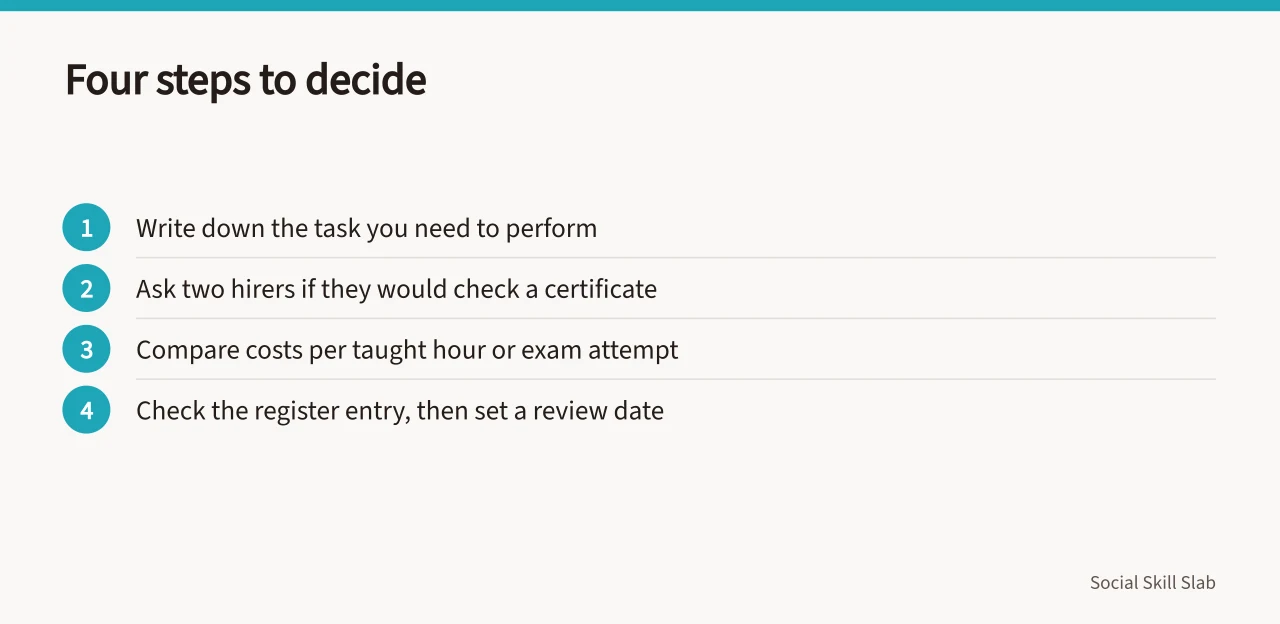
Four steps to decide
- Write down the task you need to perform, such as running a paid campaign or answering complaints in public.
- Ask two people who would hire you whether they would ever check a certificate for that task.
- Compare costs per unitper taught hour for a course, per exam attempt for certification.
- Check the register entry or issuing body, then set a review date to test whether it earned its place.
Our look at whether a social media certification is worth it covers the fee, exam and renewal question in more detail.
Where cost, time and recognition diverge
Illustrative figures only, not live quotes: a two-day classroom course at £650 per learner, against a certification pathway at £300 covering materials and one exam attempt.
The course is cheaper per learner. The certification takes longer and produces evidence a stranger can verify. Which is better depends on who pays and what they need to see.
Time is the hidden cost. A two-day course removes two working days from the business, while a certification pathway spreads its hours over several weeks.
Ask whether the quoted price includes VAT. Course and certification prices are often shown without it, and the two are rarely comparable until they sit on the same basis.
Small business owners usually fund their own training, so a course that improves this week's posting can beat a badge nobody asks about.
Agencies selling retained work face the opposite pressure. A certification in a pitch deck answers a procurement question before anyone asks it, and our breakdown of which qualification UK employers ask for shows what hiring teams actually list.
Common questions
Do I need a certification to work in social media?
Not in law. Social media work is not a regulated profession in the UK, so no licence is required.
Is a diploma better than a certification?
Not automatically. A diploma is usually a longer award with units and credits, while a certification is a narrower exam. Read the syllabus and the assessment, not the label.
Which is cheaper, a course or a certification?
Per learner, a short course usually is. Check what sits outside the headline price, including exam resits and materials.
Does an Ofqual-regulated award matter to employers?
Sometimes. Regulated awards are easier to verify and may open funding routes in England. In platform teams, a working portfolio still tends to decide.